

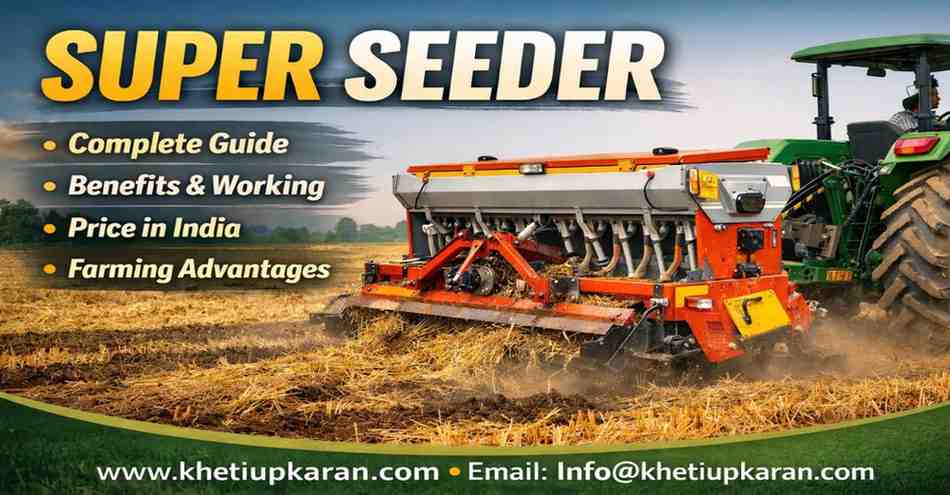
Super Seeder: Complete Guide, Benefits, Price, Working & Farming Advantages
Introduction
In modern agriculture, efficient farm machinery can be a game changer — especially for managing crop residue. One such innovative implement is the Super Seeder, a machine designed to cut, mix, and sow seeds in fields with leftover straw or stubble. This blog covers everything you need to know about the Super Seeder: how it works, its benefits, price range, advantages for farmers, and why it’s becoming the preferred choice for sustainable farming in India.
What is a Super Seeder?
A Super Seeder is a tractor-mounted crop residue management machine that performs three major operations in one pass:
- Chopping and lifting crop residue
- Mixing straw with soil
- Sowing seeds simultaneously
Traditionally, farmers burn paddy stubble after harvest to clear land, but this causes severe air pollution and soil degradation. The Super Seeder offers an environmentally friendly and economical alternative by eliminating the need for burning and preparing the soil for the next crop in a single go.
How Does a Super Seeder Work?
The working mechanism of the Super Seeder revolves around efficiency and automation. Here’s a step-by-step breakdown:
- Mounted on the Tractor: The Super Seeder is attached to a tractor’s three-point linkage and driven by the tractor’s PTO (power take-off).
- Cutting Residue: Heavy blades on the front side slice and lift paddy straw and stubble.
- Mixing with Soil: The rotating blades mix trimmed residue with the top layer of soil to enhance decomposition.
- Seed Drilling: A seed drill unit places seeds at the optimum depth and spacing for germination.
- Soil Cover: The machine covers the sowed seeds with soil, providing a suitable seedbed.
This multi-task performance saves time and manpower.
Why Super Seeder is Important for Farmers
- No More Stubble Burning
Crop residue burning is a widespread issue in northern India, particularly after paddy harvests. It releases harmful pollutants like particulate matter (PM2.5 and PM10) and greenhouse gases that:
- Damage air quality
- Cause health issues
- Destroy soil organic content
- Increase carbon emissions
The Super Seeder helps reduce stubble burning by cutting and incorporating residue directly into the soil.
- Saves Time and Labor
With the power to chop straw, prepare land, and sow seeds in one operation, farmers save precious time. This is especially beneficial during tight sowing windows between paddy harvest and wheat planting.
- Reduces Costs
Using multiple machines — rotavators, ploughs, and seed drills — increases fuel and labor costs. The Super Seeder consolidates operations, significantly reducing input costs.
Benefits of Using a Super Seeder
- Improved Soil Fertility
Incorporating crop residue into the soil increases organic matter. Over time, this enhances soil structure and moisture retention, leading to healthier crops and potentially higher yields.
- Better Seed Germination
The machine places seeds uniformly at the recommended planting depth. This encourages better seed-to-soil contact, which improves germination and crop establishment.
- Environmental Protection
Instead of burning, crop residue is used as a natural mulch, decreasing dust and pollution while maintaining ecological balance.
- Fuel Efficiency
Although the machine requires a moderately powered tractor (usually 45–75 HP), it reduces the need for multiple field operations. This translates into lower fuel consumption overall.
- Reduces Weed Growth
Incorporating straw into the soil helps suppress weed growth by interrupting their life cycle and reducing weed seed germination.
Super Seeder vs Other Implements
To understand its value, let’s compare the Super Seeder with other common tools:
| Feature | Super Seeder | Rotavator | Happy Seeder |
| Residue management | Yes | No | Yes (mulch) |
| Seed sowing | Yes | No | Yes |
| Soil disturbance | Moderate | High | Minimal |
| Best for heavy residue | Yes | No | Yes |
| Environmental impact | Positive | Neutral/Negative | Positive |
Key takeaway: Super Seeder combines the functions of land preparation and seeding, offering both productivity and ecological benefits.
Super Seeder Price in India (2026)
The price of a Super Seeder machine in India can vary based on brand, size, and capabilities. However, as of 2026, the typical price range is:
₹1,80,000 – ₹3,50,000 INR
Prices may differ depending on:
- Working width of the machine
- Brand and build quality
- Warranty and after-sales service
In many states, farmers are eligible for government subsidies (under various agricultural modernization programs). These subsidies can significantly lower the actual purchase cost, making Super Seeders more affordable.
Which Tractor is Suitable for Super Seeder?
A Super Seeder generally requires a tractor with the following specifications:
- Horsepower: 45–75 HP (higher HP recommended for larger machines)
- Weight: Sufficient to handle pull and stability
- PTO Speed: Standard 540 RPM
- Rear Linkage: Three-point linkage compatibility
Small-scale farmers with lower HP tractors can consider renting a larger tractor or using a custom hiring center.
Advantages of Super Seeder for Farming
- Quick Turnaround Between Crops
After paddy harvest, there’s a narrow window to sow wheat or other Rabi crops. The Super Seeder allows rapid land preparation, maximizing the sowing period.
- Enhances Crop Yield
Consistent seed placement and improved soil health can lead to better crop performance and increased yield potential.
- Eco-Friendly Farming
By reducing the need for burning residue, the Super Seeder helps farmers adopt environmentally responsible practices, contributing to cleaner air and soil.
- Works Well in Heavy Residue Fields
For farmers dealing with thick paddy stubble, a Super Seeder significantly outperforms traditional seed drills that can get choked or clogged.
Maintenance Tips for Super Seeder
To ensure durability and long service life, regular maintenance is essential:
- Check blades: Replace worn or damaged cutting blades.
- Lubrication: Grease bearings and moving parts frequently.
- Clean seed box: Keep the seed box free from dust and moisture.
- Inspect chains and belts: Replace any worn or weak components.
- Proper storage: Store indoors to avoid rusting from seasonal monsoon humidity.
Good maintenance improves performance and reduces long-term repair costs.
Who Should Buy a Super Seeder?
These categories of farmers benefit most:
- Paddy growers transitioning to wheat
- Farmers in high residue regions
- Custom hiring service providers
- Large farmland owners
- Mechanized farming adopters
Small farmers may also benefit through shared ownership, cooperative societies, or government subsidy programs.
Success Stories: How Super Seeder Changed Farming
Across many states in India, farmers adopting Super Seeder have reported:
- Lower field preparation costs
- Higher crop yield
- Reduced air pollution
- Less dependency on labor
- Faster sowing operations
These success stories reflect not only economic gains but also environmental stewardship.
Conclusion
The Super Seeder stands out as a complete solution for modern farmers looking to tackle crop residue challenges while maintaining productivity and sustainability. With its triple-function capability — cutting, mixing, and sowing — it simplifies what used to be multiple labor-intensive processes into one efficient pass.
By improving soil health, reducing pollution, and saving time and money, the Super Seeder machine is truly transforming Indian agriculture in 2026 and beyond.
